How Julian Dates Fit the FDA Food Traceability Rule
Search results often imply that the FDA requires manufacturers to stamp a Julian date on food packaging. That is too simplistic. The FDA's traceability framework is concerned with lot identification and record linkage, not with forcing one visible label format onto every product.
The useful way to frame it is this: a Julian production code can be part of a compliant traceability system, but the rule is about traceability data quality and chain-of-custody discipline — not about the words "Julian date" themselves.
The Short Answer
The FDA does not mandate a Julian date on the package. It requires firms handling certain foods to keep linked records keyed to a traceability lot code. A Julian production code is one practical, FDA-acknowledged way to build that lot identity — not a legal requirement on its own.
What the Rule Is Actually About
The FDA Food Traceability Rule, finalized under the Food Safety Modernization Act, establishes additional recordkeeping requirements for foods on the Food Traceability List. The goal is to let FDA and supply-chain partners identify affected lots faster during an outbreak, recall, or public-health investigation.
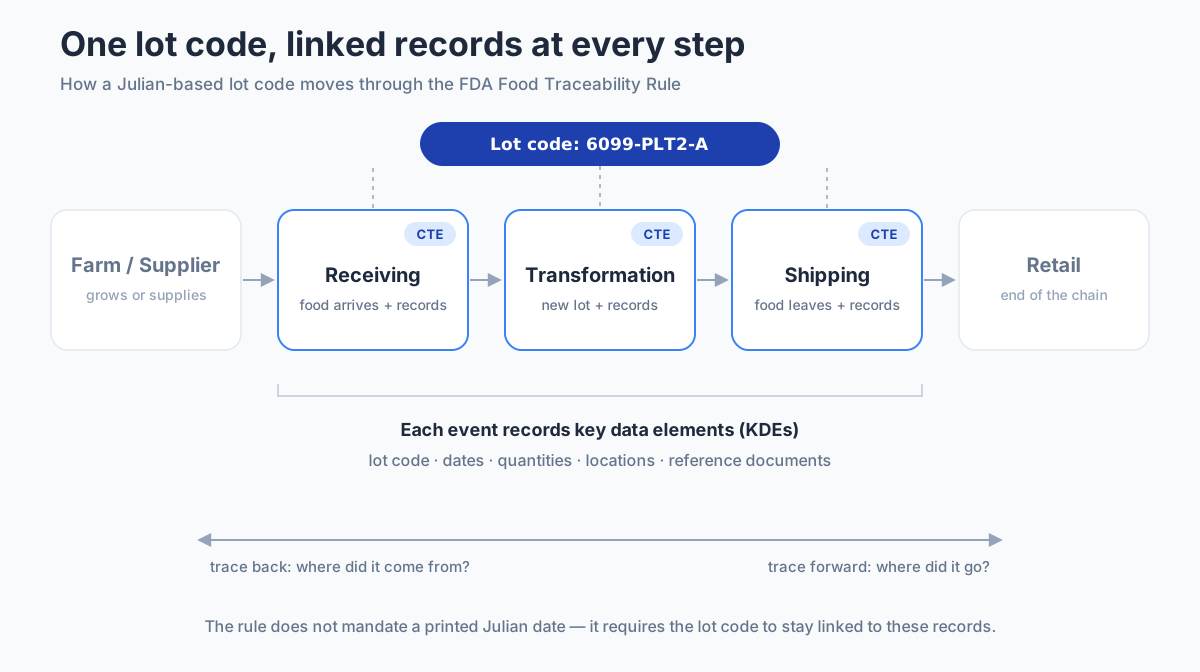
The central unit in the rule is the traceability lot code (TLC). FDA describes it as the identifier that uniquely ties a traceability lot to the records of the firm that assigned it. The records are captured at critical tracking events — receiving, transforming, creating, and shipping — and each must carry the key data elements that let investigators follow the food forward and backward through the chain.
The Critical Tracking Events at a Glance
| Event | Who records it | What the records must capture |
|---|---|---|
| Harvesting / cooling | Farms and cooling operations | What was harvested or cooled, where, when, and for whom |
| Initial packing | First packer of a raw agricultural commodity | Assigns the first TLC, plus quantities, dates, and locations |
| Receiving | Anyone taking possession of a listed food | TLC received, quantity, ship-from location, date, reference documents |
| Transformation | Manufacturers and processors | Input TLCs consumed, new TLC assigned, quantities in and out |
| Shipping | Anyone sending a listed food onward | TLC shipped, quantity, ship-to location, date, reference documents |
The pattern to notice: the TLC is assigned at initial packing or transformation, and then every later event must keep referring to it. That continuity — not any particular label format — is what the rule audits.
Where Julian Codes Fit
FDA's traceability-lot-code guidance explicitly says firms have flexibility in how they assign a traceability lot code. The agency even cites a "Julian date plus product code" style of assignment as an acceptable method inside a traceability plan.
That lines up with how real plants already operate. A four- or seven-digit Julian production code is compact, sortable, and easy to combine with a product identifier, plant code, shift code, or line code. It is a practical building block for lot identity even when it is not sufficient by itself. If you need to read those codes, the batch decoder and the manufacturing guide cover the common formats.
Building a TLC From a Julian Date
Here is what the "Julian date plus product code" pattern looks like in practice, using April 9, 2026 (day 099) as the production day:
| Component | Example | What it encodes |
|---|---|---|
| Julian production date | 6099 | Year 2026 (final digit) + day 099 of the year |
| Plant identifier | PLT2 | Which facility produced the lot |
| Line or shift | A | Which line or shift within the day |
| Resulting TLC | 6099-PLT2-A | Unique lot identity that records can reference |
Notice what the bare Julian day cannot do on its own: 6099 repeats every ten years, says nothing about which plant or product it belongs to, and collides with every other line running that day. The surrounding identifiers are what turn a date stamp into a lot identity.
What the Rule Does Not Require
The rule does not require every food package to print a standalone Julian date for consumers, and it does not prescribe a single visible label format across the industry. A compliant firm can transmit the relevant lot information through records, invoices, bills of lading, advance shipment notices, or other linked documentation.
FDA also makes clear that the traceability lot code does not have to appear on consumer-facing packaging. That is a useful correction to many low-quality summaries on the web. A code can be operationally central even when it is carried only in back-office documents or internal production records.
Why Manufacturers Still Use Julian Production Dates
Even without a label mandate, Julian production codes remain attractive because they solve three problems at once:
- They compress a production day into a short, machine-friendly field.
- They sort naturally in databases and warehouse systems.
- They give operations teams a durable anchor for recall windows and stock rotation.
In other words, the FDA rule did not create Julian date usage. It sits on top of an industrial habit that was already widespread because the format works well in production and distribution systems.
The Practical Compliance Point
For a manufacturer or co-packer, the operational question is not "Should we use a Julian date or not?" The better question is: "Can our lot identifier, whether Julian-based or not, stay linked to the required records at each critical tracking event?"
A bare Julian day can be too weak if it does not distinguish product, location, or transformation event. A Julian day combined with a product code, plant identifier, or internal lot key is much stronger. FDA's framework is fully compatible with that more realistic, layered approach.
How the Compliance Deadline Has Moved
- November 2022 — FDA publishes the final Food Traceability Rule under FSMA Section 204.
- January 20, 2026 — the original compliance date, still quoted by many outdated summaries.
- March 2025 — FDA announces its intention to extend the compliance window by roughly 30 months.
- July 20, 2028 — the date before which FDA has said it does not intend to enforce the rule, consistent with the Congressional directive.
If a vendor or consultant quotes the January 2026 date as current, that is a sign the material has not been maintained.
Where That Leaves Julian Dates
Julian production dates are not the rule. They are one practical component that can support the rule. The real compliance standard is whether the lot identifier and its associated records let a firm trace food efficiently through receiving, transformation, shipping, and recall response.
For a quick operational reference, use the batch decoder, the converter, and the manufacturing guide together. They cover the visible code formats, the date math, and the supply-chain context in one place.
Related Tools
Sources and further reading: FDA: FSMA Food Traceability Final Rule and FDA: Traceability Lot Code.