UTC vs GMT: What’s the Difference and Which Should You Use?
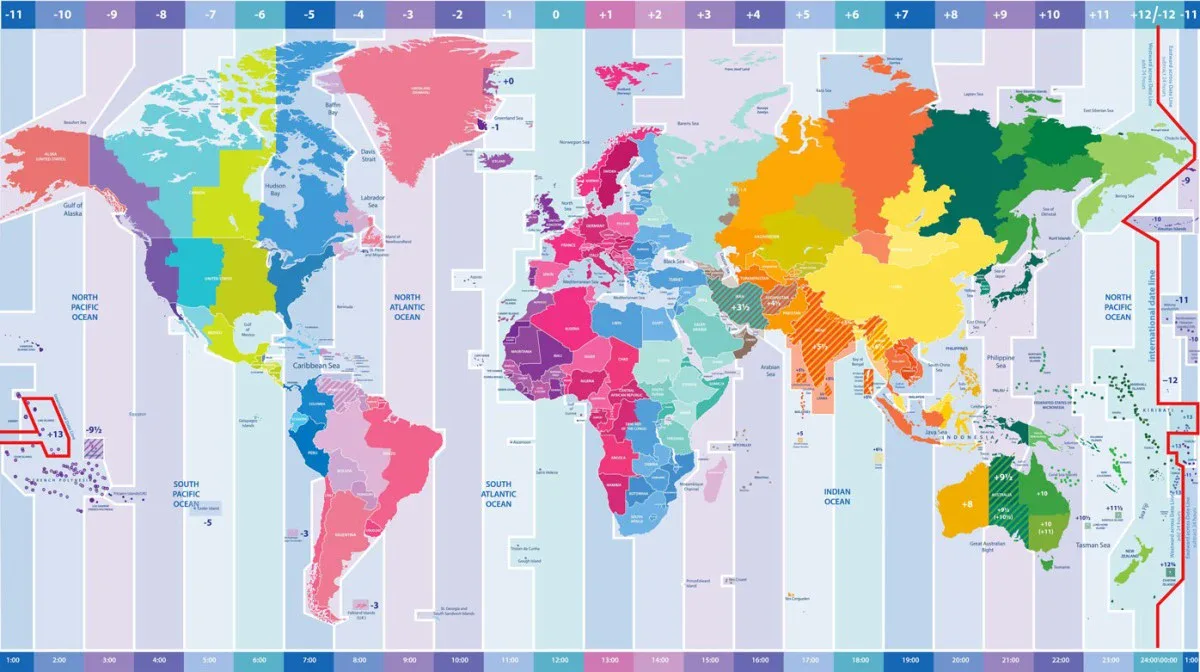
People often use UTC and GMT as if they were interchangeable. In everyday conversation that usually works. If somebody says a meeting starts at 14:00 UTC or 14:00 GMT, the intended clock time is normally the same.
But the two terms are not identical in meaning. UTC is the modern international reference time scale used by standards, software, aviation, telecommunications, and most technical systems. GMT began as Greenwich Mean Time, the mean solar time at Greenwich, and today survives mainly as a historical term, a legal time label in some contexts, and a zero-offset time-zone name.
The Short Answer
If you only care about the hour and minute on an ordinary clock, UTC and GMT are effectively the same most of the time. If you care about standards, sub-second precision, leap seconds, protocol wording, or the exact meaning of a time label, UTC is the more precise and modern term.
| Aspect | UTC | GMT |
|---|---|---|
| What it is | The modern international reference time scale | Originally mean solar time at Greenwich; now often a zero-offset zone label |
| Basis | Atomic time, coordinated internationally, with leap seconds | Historically tied to astronomical observation and mean solar time |
| Used in modern standards | Yes | Mostly as a legacy or zone label |
| Daylight saving time | Never changes for DST | GMT itself stays at UTC+0, but places such as the UK switch away from GMT in summer |
| Best default term | Software, APIs, data exchange, international coordination | Historical discussion, legal British winter time, legacy protocol wording |
1. What UTC Actually Is
UTC stands for Coordinated Universal Time. It is the internationally agreed reference time scale used for general timekeeping. According to NIST and the BIPM, UTC is based on International Atomic Time (TAI) and adjusted with leap seconds so it stays close to Earth rotation.
That point matters because UTC is not just a convenient label for “world time.” It is a technical standard designed to let clocks, networks, observatories, satellites, data centers, and national time services stay aligned. When you see offsets like UTC-5 or UTC+9, the offset is being measured from this global reference.
In practical terms, UTC is the baseline behind airline systems, cloud logs, APIs, Unix timestamps, database replication, and cross-border scheduling. If a system needs one neutral clock that does not follow local daylight saving rules, UTC is the standard choice.
2. What GMT Actually Means
GMT stands for Greenwich Mean Time. Historically, it referred to the mean solar time at the Royal Observatory in Greenwich, England. Royal Museums Greenwich notes that GMT served as the international civil time standard from 1884 until 1972.
That historical origin is why GMT has a different flavor from UTC. GMT came from astronomy and the observation of the Sun relative to the Greenwich meridian. NIST explains that the original astronomical idea behind GMT followed the irregular motion of Earth and that the modern term for that astronomical time is UT1.
Today, when people write “GMT,” they usually do not mean the old astronomical concept. They usually mean one of two simpler things:
- A UTC+0 time-zone label.
- A legacy wording choice that survived in software, documentation, or protocol text.
3. Why UTC and GMT Usually Show the Same Clock Time
Here is the source of the confusion: in normal civil use, both UTC and GMT often point to the same visible clock reading at the zero meridian. If it is 09:00 UTC, it is also 09:00 GMT in the ordinary everyday sense.
NIST explicitly says that GMT can be considered equivalent to UTC when fractions of a second are not important. That is why newsrooms, weather reports, military speech, transport timetables, and everyday conversation often move between the terms without anyone noticing a problem.
For most humans, that shortcut is fine. For standards and software, it is better to be precise about which system you mean.
A Useful Rule of Thumb
If you are explaining time to people, GMT and UTC often describe the same hour. If you are defining time for code, protocols, storage, or international systems, say UTC unless you specifically mean the GMT time zone or a legacy format.
4. Where the Difference Starts to Matter
The difference matters most when precision, standards, or semantics matter more than casual speech.
- Scientific and technical contexts: UTC is the formal reference scale used internationally.
- Leap seconds: UTC can be adjusted by leap seconds to stay close to Earth rotation. GMT as a casual time-zone label does not carry that full technical meaning.
- Historical or astronomical discussion: GMT has a historical meaning tied to Greenwich and solar time, while UTC is a modern coordinated standard.
- Data exchange and APIs: UTC is clearer because it avoids the ambiguity of whether “GMT” is being used historically, legally, or casually.
That does not mean you need to ban the letters GMT from your vocabulary. It means you should know when a casual synonym stops being precise enough.
5. London Is Not Always on GMT
This is one of the most common real-world mistakes. People hear that London is the home of GMT and then assume London time is always GMT. It is not.
In the UK, GMT is the legal winter time. During summer, the UK switches to British Summer Time (BST), which is UTC+1. So a summer meeting in London is not happening on GMT even though Greenwich remains the historical reference point.
That is why “London time” is a better planning phrase than “GMT” only when you are also checking the date. If the date lands in summer, London time may be one hour ahead of GMT. Our time zone converter handles that automatically for the exact date involved.
6. Why Developers Still See GMT in Headers and Logs
Even though UTC is the modern standard term, the internet still contains older protocol language that says GMT. A good example is HTTP. RFC 9110 says an HTTP-date represents an instant in UTC, but the wire format still uses the literal string GMT.
That is why HTTP headers look like this:
The label says GMT, but the specification says the value represents UTC. This is not a contradiction so much as a legacy format that stayed in place for compatibility. The same thing happens in older email, server, and logging conventions.
If you are converting these values into machine-readable formats, treat them as UTC instants. If you want to inspect epoch values, ISO 8601 strings, or protocol dates, the Unix timestamp converter is the better tool than eyeballing them by hand.
7. Why the Abbreviation Is UTC and Not CUT
This is one of those small details that people remember because it sounds odd. NIST explains that when the coordinated universal time system was devised, the international group behind it wanted one abbreviation that did not favor English or French. English would have suggested CUT, while French would have suggested TUC from temps universel coordonné. The compromise was UTC.
It is a small detail, but it reveals what UTC really is: not a local custom, but a global coordination standard.
8. Which One Should You Use?
The safest default is simple:
- Use UTC for software, APIs, databases, timestamps, logs, infrastructure, aviation, and international scheduling baselines.
- Use GMT when you truly mean the GMT time zone, when you are discussing historical timekeeping, or when you are dealing with a protocol or document that explicitly uses the GMT label.
- Use full IANA time-zone names such as
Europe/LondonorAmerica/New_Yorkwhen a human event depends on daylight saving rules.
That last point is the one most people miss. If you schedule a meeting as “10:00 UTC,” everyone can convert from a fixed baseline. If you schedule it as “10:00 London time,” then the correct UTC offset depends on the date. If you schedule it as “10:00 GMT” in summer, you may already be one hour wrong.
The Bottom Line
UTC and GMT often match on the clock, but they are not the same concept. UTC is the modern coordinated reference scale used by international standards and technical systems. GMT is the historical Greenwich term that now survives mainly as a zero-offset time-zone label, a British winter-time label, and a legacy format in some protocols.
If you want the practical rule: use UTC by default, use specific time-zone names for local events, and treat GMT as a term that is still common but narrower and older. That keeps your language accurate and your scheduling less error-prone.
Related Tools
Sources and further reading: NIST on UTC, GMT, TAI, and Zulu time, BIPM time metrology overview, Royal Museums Greenwich on GMT, and RFC 9110 HTTP date/time formats.