Julian Date vs. JDN vs. MJD: Four Terms People Confuse

The most common Julian-date mistake on the web is not a bad calculation. It is a vocabulary mistake. Someone uses "Julian date" to mean the day of year printed on a soup can, searches for it, lands on an astronomy page about a 2.4-million-day count, and leaves more confused than when they started.
The fix is to separate four different ideas that are routinely collapsed into one phrase: the ordinal day of year, the Julian Day Number (JDN), the Julian Date (JD), and the Modified Julian Date (MJD). They look similar on the page, but they come from different worlds and answer different questions.
The Short Answer
A 3-, 4-, 5-, or 7-digit code on a package is an ordinal production date. A number near 2.4 million is an astronomical JD or JDN. A number near 60,000 is an MJD. The size of the number tells you which world you are in.
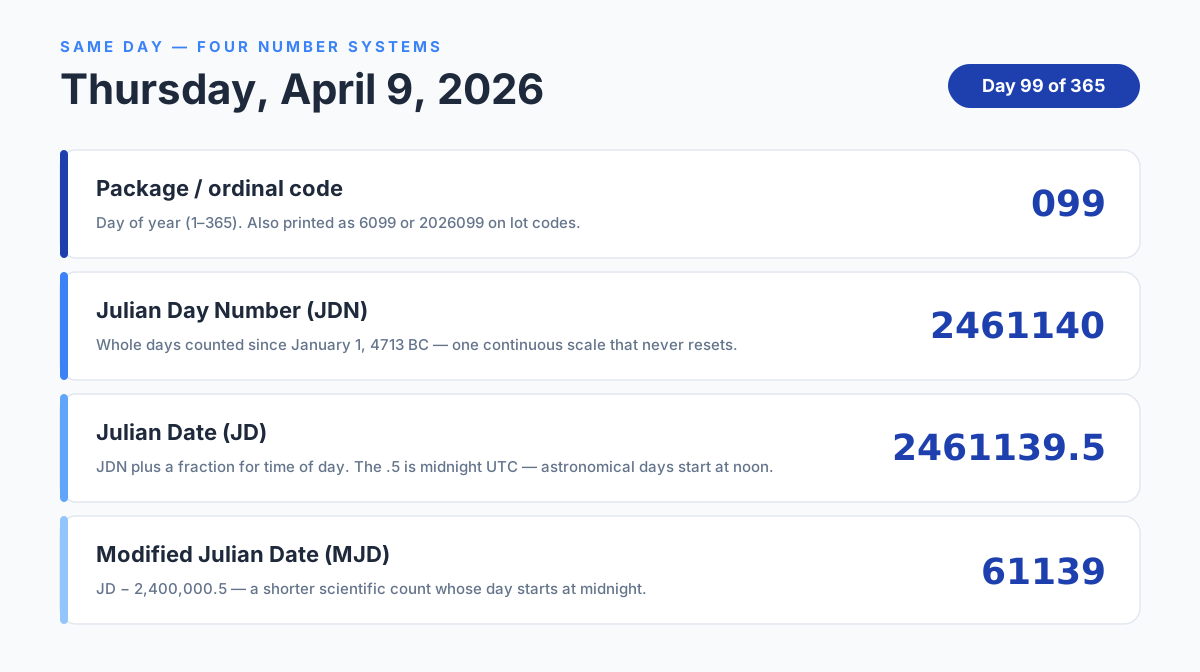
| Term | What it counts | April 9, 2026 as… | Where it is used |
|---|---|---|---|
| Ordinal day of year | Day 1–365/366 within a single year | 099, 6099, 2026099 | Packaging, lot codes, logistics |
| Julian Day Number | Whole days since a fixed epoch | 2461140 | Astronomy, calendar math |
| Julian Date | Days plus fraction for time of day | 2461139.5 | Astronomy, precise timing |
| Modified Julian Date | JD shifted to midnight, minus 2,400,000.5 | 61139 | Geodesy, satellites, scientific systems |
1. Ordinal Day of Year
In manufacturing, logistics, and consumer packaging, "Julian date" almost always means the ordinal day of year: 1 through 365, or 366 in a leap year. That is the number behind formats like 099 (the 99th day), 6099 (year 2026, day 099), or 2026099 (full year plus day).
This is not the astronomical Julian Date. It is a compact production-date convention built around the day of year, useful because it fits a tiny print area and sorts cleanly in a database. If you want the full set of encodings, the Julian date formats guide breaks them down, and the converter turns any of them into a calendar date.
2. Julian Day Number (JDN)
The Julian Day Number is an integer count of days on one continuous scale that never restarts at the year boundary. The U.S. Naval Observatory describes the Julian date system as a count of days and fractions since noon Universal Time on January 1, 4713 BC in the Julian calendar. The JDN is simply the whole-day index on that scale.
If you are looking at a number like 2461222, you are in JDN territory, not food-package territory. The sheer magnitude is the giveaway. The point of a single continuous count is that you can subtract two values and get the exact number of days between any two dates, with no leap-year bookkeeping in the way.
3. Julian Date (JD)
The Julian Date is that same continuous day count with a fractional component for the time of day. The noon starting point matters more than people expect: under the astronomy convention, midnight corresponds to a fractional value of .5, not .0. Noon is the whole-number boundary.
That single convention causes a large share of real-world bugs. Developers instinctively expect a civil day to begin at midnight, but astronomical JD puts the day boundary at noon so that a single night of observation never gets split across two day numbers. If your code is off by half a day, this is usually why.
4. Modified Julian Date (MJD)
MJD is a shorter scientific form defined by the relationship MJD = JD − 2400000.5. USNO uses that formula directly in its reference material.
The subtraction does two useful things for modern work. First, it removes the leading millions, so values land in the tens of thousands instead of the millions. Second, the half-day offset shifts the day boundary back to midnight, which is far more natural for civil and operational systems. That is why satellite, geodesy, and timekeeping systems tend to prefer MJD over raw JD.
Why These Get Mixed Up
The confusion is historical. The manufacturing world borrowed the word "Julian" for ordinal production dates, while astronomy kept the original continuous-day meaning. Search queries then blended the two audiences together. That is why one person wants 6099 decoded as a food code and another wants 2461222.5 interpreted as a scientific epoch — both typed "Julian date" into the same box.
A Quick Rule of Thumb
- If the number is 3, 4, 5, or 7 digits and tied to a package or requisition, it is an ordinal production-date format.
- If the number is around 2.4 million, it is JDN or JD.
- If the number is in the low 60,000s, it is probably MJD.
- If the value carries a .5 at midnight, you are in astronomical JD territory.
How to Convert Between Them
Once you know which system you are holding, moving between them is arithmetic. These four relationships cover almost every real conversion:
| Conversion | Formula |
|---|---|
| JD → MJD | MJD = JD − 2400000.5 |
| JDN → JD at midnight UTC | JD = JDN − 0.5 |
| Unix time → JD | JD = unix / 86400 + 2440587.5 |
| JD → Unix time | unix = (JD − 2440587.5) × 86400 |
The constant 2440587.5 is the Julian Date of the Unix epoch — midnight UTC on January 1, 1970 — which is why it appears in both Unix conversions. It also makes a handy sanity check for any converter you write.
A Worked Example You Can Verify
Take April 9, 2026 at 00:00 UTC — the same day used throughout this article — and run it through every system:
- Unix timestamp: 1775692800 seconds
- JD = 1775692800 / 86400 + 2440587.5 = 20552 + 2440587.5 = 2461139.5
- MJD = 2461139.5 − 2400000.5 = 61139
- JDN (the whole-day index, anchored at the following noon) = 2461140
- Ordinal day of year: 099 — the number a factory would stamp as 6099 or 2026099
Every value agrees with the table above. If you run the same date through the Julian date converter, you should get identical numbers — and the developer snippets page has these formulas ready to paste in several languages.
What to Use Where
Use ordinal formats such as DOY, YJJJ, or YYYYJJJ for packaging, lot tracing, and military logistics documents. Use JDN when you need an unambiguous whole-day astronomical index. Use JD when the time of day matters. Use MJD when you want a shorter scientific day count aligned to midnight.
If you mostly deal with the manufacturing side, the Julian date overview and batch decoder are the fastest follow-ups. For the full encoding reference, see the formats guide; to convert a specific value, use the converter.
Related Tools
Sources and further reading: U.S. Naval Observatory Julian Date Converter and USNO: Converting Between Julian Dates and Gregorian Calendar Dates.